
Latest News
FIFA investigates Argentina over Falklands banner after World Cup semi-final win

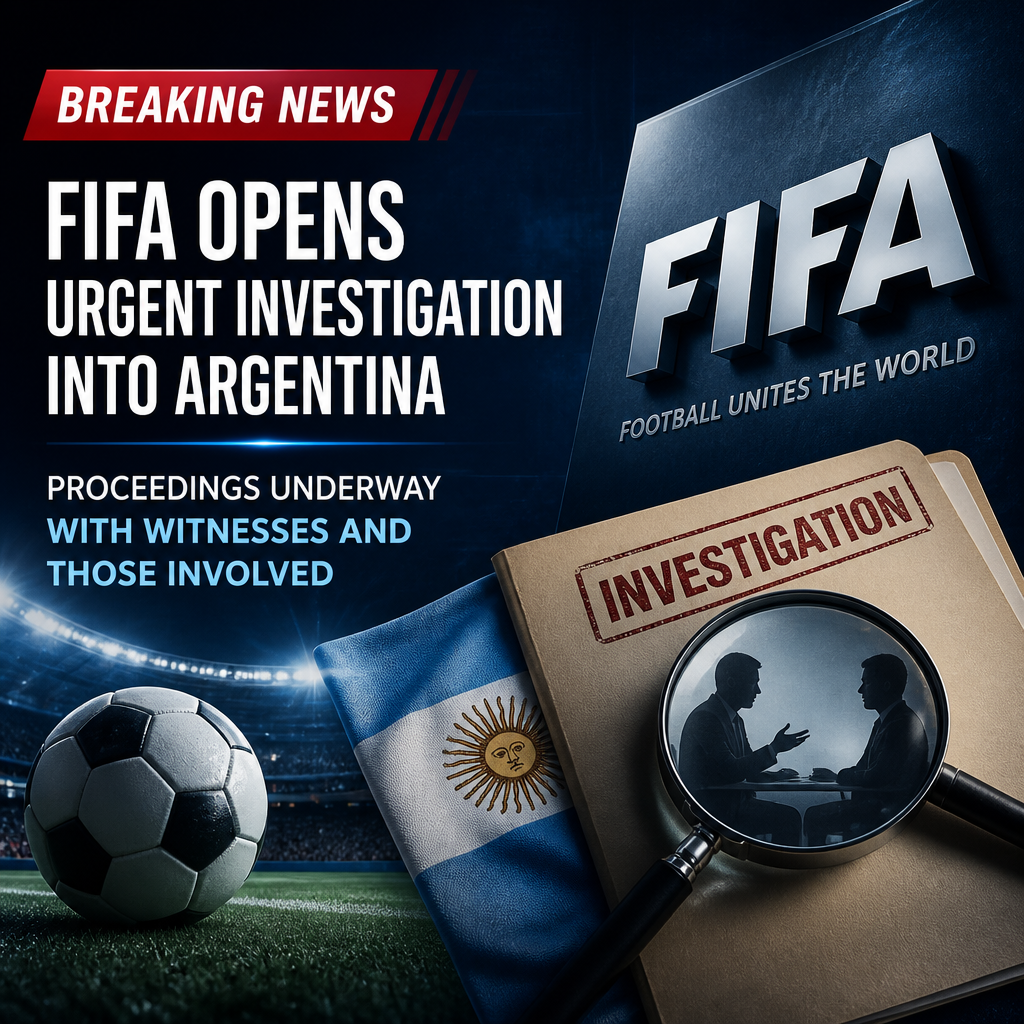
FIFA has launched a formal investigation into Argentina’s politically charged celebrations following their dramatic World Cup semi-final victory over England, after players posed with a banner declaring: “The Falkland Islands are Argentine.”
The match, which Argentina won 2-1 after coming from behind in a frenetic encounter, ended with the pitch turning from a scene of sporting celebration into a platform for a provocative political message over the long-disputed South Atlantic territory.
According to Spanish newspaper AS, the incident has triggered disciplinary action by world football’s governing body, which bans all political statements at its competitions.
Banner turns celebrations into political flashpoint
In the immediate aftermath of the final whistle, Argentina’s players brought a large banner onto the turf bearing the slogan: “Las Malvinas son Argentinas” – translated as “The Falkland Islands are Argentine.”
AS reported that at first there was confusion over the wording, with some early accounts suggesting the banner read “Falkland Islands without Argentina”. Subsequent images and reporting clarified that the message asserted Argentine sovereignty over the islands.
The banner quickly became the focal point of the celebrations. AS wrote that Giovani Lo Celso took a commemorative photograph with it, laid it down on the grass, and was then joined by team-mates who gathered around, turning it into the centrepiece of the post-match scenes.
Images of the players celebrating behind the slogan spread rapidly on social media, reigniting sensitivities around the Falklands/Malvinas dispute, which led to a brief but bloody conflict between the UK and Argentina in 1982.
FIFA opens case and weighs sanctions
FIFA regulations strictly prohibit political, religious or personal slogans, statements or images at its tournaments – rules which apply especially stringently at the World Cup given its global profile.
AS reports that FIFA has now opened a formal case to collect evidence and hear from those involved in displaying the banner. The Argentine Football Association (AFA) is expected to be held responsible for the conduct of its players.
The governing body is currently considering two possible types of sanction, the newspaper says: a financial penalty or a suspension for those directly involved.
However, all indications at this stage point towards a fine for the AFA rather than match bans for individual players. Lo Celso, identified as the player who placed the banner on the pitch and posed with it, is considered the central figure in the incident but is not currently expected to be suspended.
Within hours, the AFA is set to receive an official notification from FIFA, after which a formal process of hearings and submissions will begin. The final decision is expected to focus on the association itself rather than targeting specific squad members.
Sharp contrast with Scaloni’s pre-match stance
The episode stands in stark contrast to the tone struck by Argentina head coach Lionel Scaloni in the build-up to the semi-final against England.
Days before the match, Scaloni had played down any wider meaning attached to the fixture, insisting he wanted it to be seen purely through a sporting lens.
He said: “انها مجرد مباراة كرة قدم” – “It’s just a football match.”
Yet his players’ actions after the final whistle suggested that, for some within the squad, the meeting with England carried deeper symbolic significance. Rather than avoiding political overtones, the team embraced the banner and used it as a backdrop for victory photos amid jubilant celebrations.
Previous incidents and likely outcome
AS notes that there is precedent involving both sides of this dispute. A similar case occurred in a friendly between Argentina and Slovenia, when a banner carrying the same Falklands message was displayed. On that occasion, the punishment was a financial penalty.
Those past decisions, combined with the limited time before the World Cup final and the complexity of the geopolitical issue, have led observers to expect a comparable outcome now – a fine for the AFA rather than sporting sanctions that would disrupt the tournament’s showpiece match.
FIFA, though, is keen to signal that it will act swiftly. Despite acknowledging that the matter extends well beyond football, the organisation is determined to enforce its regulations and is moving to open proceedings immediately.
