
Latest News
Morocco back coach Mohammed Ouahbi despite World Cup quarter-final exit

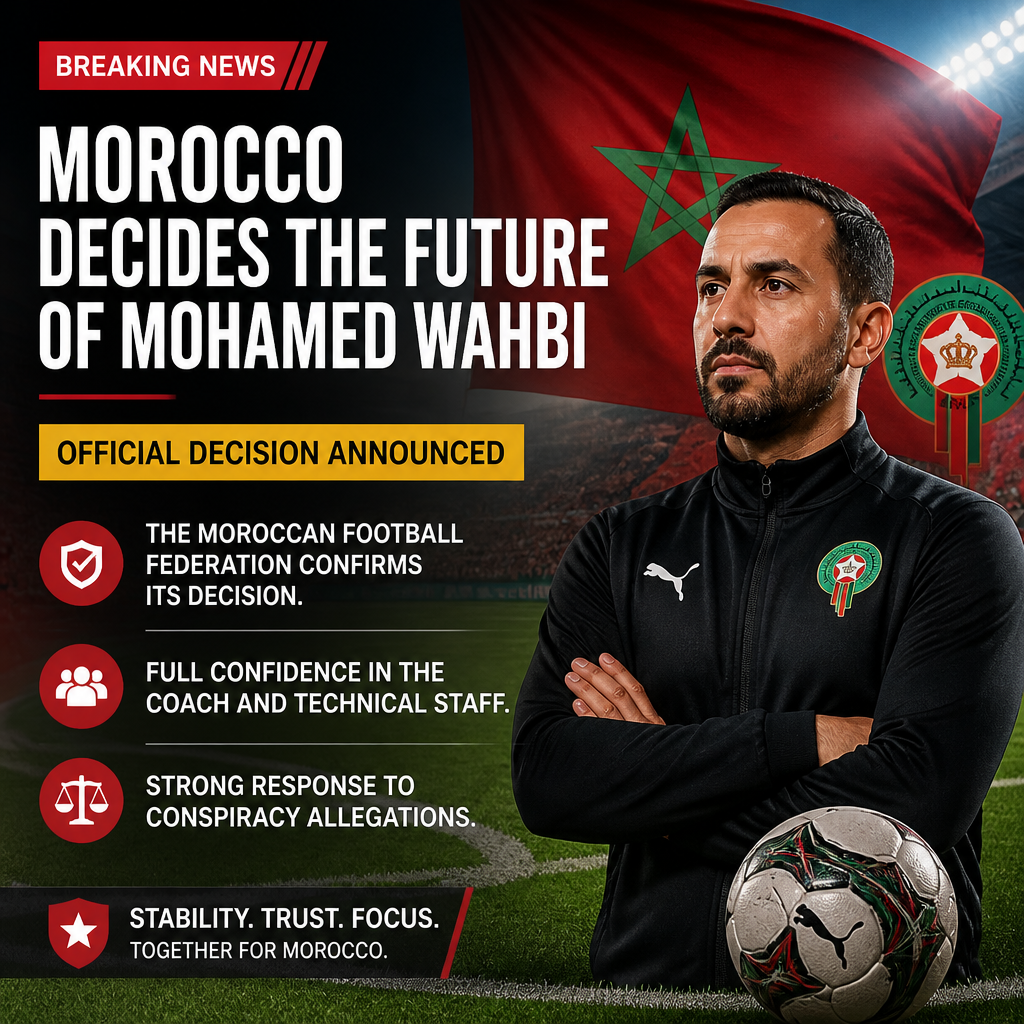
Morocco have given head coach Mohammed Ouahbi their full backing to lead the national team towards the 2030 World Cup, despite a painful quarter-final elimination at the 2026 finals in the United States, Canada and Mexico.
The Royal Moroccan Football Federation (FRMF) confirmed its position after a meeting of its executive committee, moving quickly to end speculation over Ouahbi’s future following the 2-0 defeat by France.
A video published on the FRMF’s official account on X showed Abdelssalam Belkchour, president of the National Professional Football League, outlining the conclusions of the meeting chaired by federation chief Fouzi Lekjaa.
Belkchour said the gathering had been devoted to a detailed review of Morocco’s World Cup campaign, which ended in the last eight, and insisted that the team’s performance should be seen as a significant achievement on the road to co‐hosting the 2030 tournament.
Federation rejects ‘conspiracy’ claims
Belkchour used his remarks to strongly condemn allegations that some Morocco players had shown a lack of effort or even conspired during the defeat to France.
He described such accusations as unfair and unfounded, stressing that the squad had produced committed displays throughout the competition.
He said the national team, known as the Atlas Lions, had delivered “an important achievement” at the World Cup, arguing that the progress made under Ouahbi laid a solid foundation ahead of Morocco’s role as a joint host of the 2030 finals.
While specific tactical and technical details of the review were not disclosed, the tone from the federation was one of firm support for both staff and players, and of irritation at criticism that questioned the team’s integrity rather than its football.
Ouahbi to lead next phase
Belkchour made clear that the FRMF had decided to renew its confidence in Ouahbi and retain him as head coach for the next phase of the national side’s development.
The move “disperses all doubts” about his continuation in the role, he said, ending days of public debate over whether a change would be made after the quarter-final exit.
Ouahbi only took charge of Morocco in March, succeeding Walid Regragui. In his first major tournament in the job, he steered the Atlas Lions into the last eight of the World Cup, suffering just one defeat – the loss to France that halted their run.
The federation’s stance suggests that stability will be prioritised as Morocco build towards 2030, with Ouahbi expected to oversee both the regeneration of the squad and preparations for hosting duties.
Looking ahead to 2030
The World Cup campaign is being framed in Rabat as part of a longer journey rather than a stand‐alone disappointment.
By emphasising the quarter-final appearance as a step forward and rejecting narratives of internal discord, the FRMF is attempting to protect the national team’s image and maintain momentum with four years to go until Morocco welcomes the world.
No further details were given on potential structural reforms, performance analysis tools or player development initiatives, though references made alongside the federation’s coverage – including mentions of “FIFA Power Rankings” and positional metrics such as attack, playmaking and defence – point to an increasing focus on data and performance evaluation.
For now, the central message from Morocco’s football authorities is clear: the Atlas Lions’ campaign in 2026 is being viewed as a platform to build on, not a crisis to react to – and Mohammed Ouahbi will remain the man trusted to lead that project.
