
Latest News
Spain dethrone Argentina as Morocco hit historic FIFA rankings high after 2026 World Cup shake-up

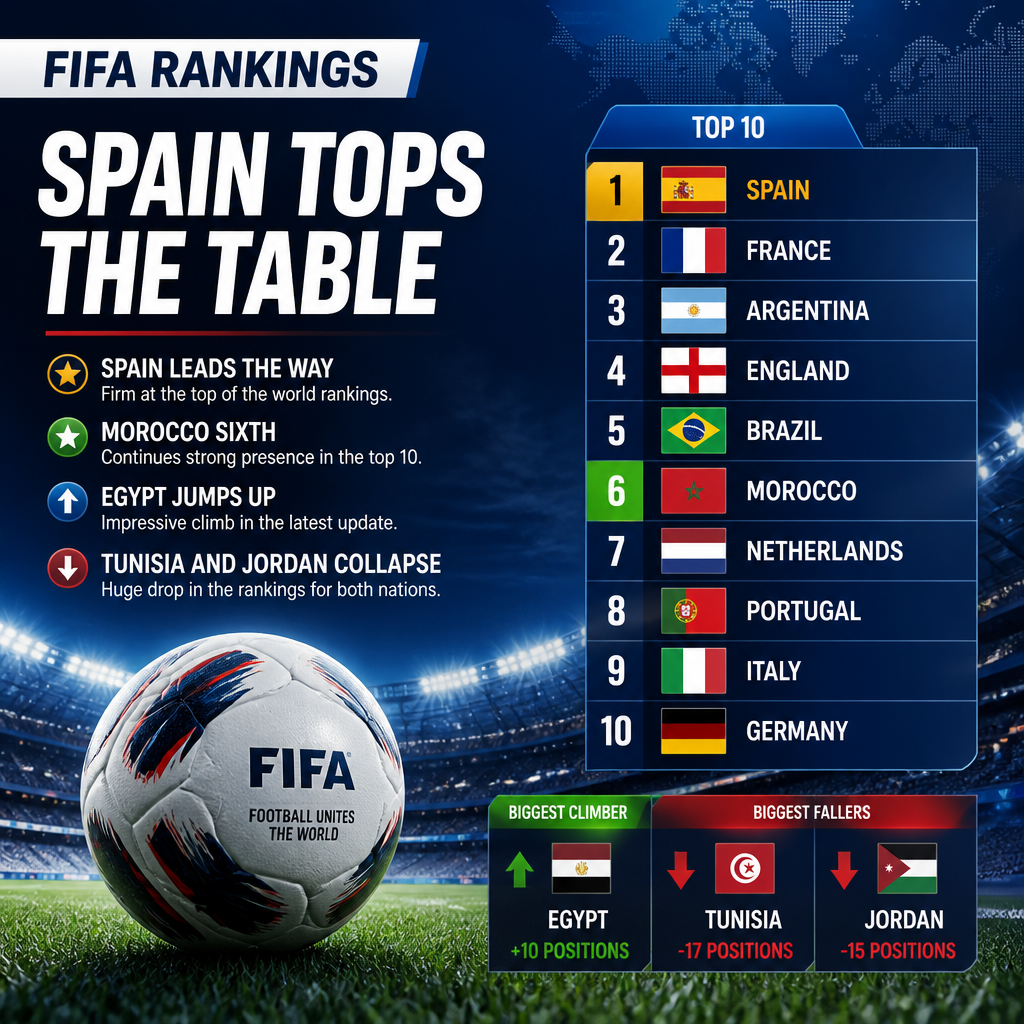
Spain have climbed to the top of the FIFA world rankings for the first time in years after winning the 2026 World Cup, as Morocco secured a record-breaking sixth place to lead all Arab and African nations in a dramatic post-tournament reshuffle.
The updated standings, released by world governing body FIFA on its official website, show major changes in the top five and sharply contrasting fortunes for Arab teams.
Spain’s 1-0 victory over Argentina in the 2026 World Cup final lifted La Roja to number one in the world, dislodging the Argentines, who had held top spot going into the tournament and now drop to second.
France remain third despite finishing fourth at the World Cup, while England rise to fourth after achieving their best performance at a finals in 60 years, reaching the semi-finals and then beating France 6-4 in a remarkable third-place play-off.
Brazil fall one place to fifth after a disappointing last-16 exit, while Morocco move up to sixth, securing the highest-ever FIFA ranking for both an Arab and an African national team.
Morocco lead Arab and African charge
Morocco have consolidated their status as the leading side in both Africa and the Arab world following another strong World Cup campaign by Walid Regragui’s team.
The Atlas Lions reached the quarter-finals of the 2026 edition before being knocked out by France, backing up their historic semi-final run at Qatar 2022 and underlining their emergence as a consistent force on the global stage.
Their rise to sixth place not only cements regional dominance but also sets a new benchmark for African and Arab football in the modern FIFA ranking era.
Egypt make biggest Arab climb
Egypt produced the most significant Arab surge in the latest rankings, jumping five places to 24th in the world. That position also makes them the second-best Arab side and third in Africa, behind Senegal, who sit 18th globally.
The Pharaohs advanced to the last 16 of the 2026 World Cup after an impressive group-stage campaign, before being eliminated by Argentina in a dramatic 3-2 defeat.
The match was overshadowed by controversy over several refereeing calls, with local media and fans questioning key decisions. Despite the exit, Egypt’s overall performance has been rewarded with a notable rise in the standings, reflecting renewed competitiveness on the world stage.
Mixed fortunes for Arab nations
The picture for other Arab teams is far less uniform, with a combination of gains, stagnation and sharp declines.
Algeria now occupy 29th place worldwide, listed as third among Arab nations and fifth in Africa, with the latest table describing them as continuing to improve in the global hierarchy. (The narrative text notes a one-place drop, despite referring to ongoing progress.)
Saudi Arabia have moved up three places to 58th in the world and are ranked fifth among Arab sides, suggesting gradual recovery after recent inconsistencies at major tournaments.
By contrast, Tunisia have suffered the heaviest fall of any Arab team in this ranking window. The Carthage Eagles have plummeted 12 places, sliding from 45th to 57th, in what is described as a severe setback for a team that had long been a regular presence in the higher reaches of the African game.
Qatar, Iraq and Jordan slide
Elsewhere in the region, Qatar have slipped three places to 59th in the world, placing them sixth among Arab teams.
Iraq have dropped to 63rd, having previously been ranked 57th, while Jordan have endured one of the steepest declines, falling 10 places to 73rd globally, which leaves them eighth among Arab nations.
The overall Arab ranking from the latest FIFA list is as follows:
– Morocco: 6th worldwide (1st Arab)
– Egypt: 24th worldwide (2nd Arab)
– Algeria: 29th worldwide (3rd Arab)
– Tunisia: 57th worldwide (4th Arab)
– Saudi Arabia: 58th worldwide (5th Arab)
– Qatar: 59th worldwide (6th Arab)
– Iraq: 63rd worldwide (7th Arab)
– Jordan: 73rd worldwide (8th Arab)
The post-World Cup reshuffle underlines Spain’s return to the summit of the men’s international game and confirms Morocco’s status as standard-bearers for both Africa and the Arab world, while exposing the growing gap in form and consistency among other regional teams.
