
Latest News
Brila report dissects 2026 World Cup business as Africa eyes next global stage

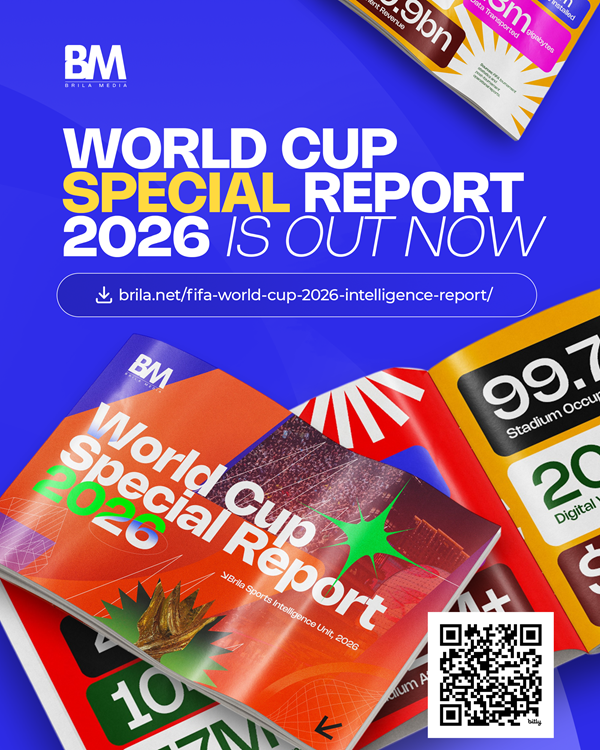
Brila Media’s Intelligence Unit has released a new “World Cup Special Report 2026”, claiming to offer African sports and media stakeholders data-driven lessons from the tournament’s off-pitch activity – from fan festivals and hospitality to boardroom decisions and entertainment programming.
The Lagos-based organisation says the report is designed to help African federations, brands and broadcasters prepare more strategically for upcoming global events, including the next FIFA World Cup, AFCON, WAFCON and the Olympics.
According to Brila, the study identifies four key insights that anyone working in sport, marketing or media on the continent “needs to understand before the next big tournament cycle”, focusing on how football’s biggest competition increasingly operates as a global entertainment and commercial platform.
Focus on numbers and revenue
Central to the report is a statistical overview of the expanded World Cup format and its commercial scale.
Brila’s Intelligence Unit highlights that the tournament featured 48 teams playing 104 matches across 16 host cities, with Fan Festivals attracting more than 7.7 million attendees. Tournament revenue is put at $10.9bn, a figure the report presents as evidence of how the World Cup has evolved into what it calls “the world’s biggest business” as well as the “world’s game”.
The organisation stresses that its work is not “a puff piece with a scoreboard” but a breakdown built on data, positioning the report as original analysis rather than a reworking of existing commentary.
Participation as “biggest currency”
One of the central themes of the publication is described as “The Biggest Currency Was Participation”, examining how countries that did not qualify for the tournament still used the event to push national interests.
The report looks at how nations from Ghana to Cape Verde, despite not having a team on the pitch, attempted to convert the World Cup’s global spotlight into tourism gains and cultural capital.
Brila argues that these efforts underline a significant missed opportunity for Nigeria in the last tournament cycle, suggesting the country did not fully exploit the attention around the competition to build its own sporting and tourism profile.
FIFA’s wider entertainment play
Brila Media’s CEO, Debbie Izamoje Okolie, frames what she sees as the tournament’s defining strategic shift, arguing that FIFA’s most significant decision was not technical or tactical.
She says the governing body’s main move “wasn’t a football innovation at all – it was a decision to compete for the world’s entertainment audience, not just its football audience”.
The report contends that this repositioning of the World Cup as a broader entertainment property shaped how host cities, sponsors and content producers approached the event, from halftime stages to fan experiences away from the stadiums.
Brila presents this as an insight that comes from having “spent 39 days embedded in the tournament’s behind-the-scenes action”, including on-site observation, to track how commercial and media strategies played out in real time.
Lessons for African brands and broadcasters
The Intelligence Unit positions the publication as essential reading for executives in sponsorship, broadcasting, brand strategy and sports business across Africa.
According to the report, it “shows exactly how brands without billion-dollar budgets still won attention”, outlining case studies of how smaller sponsors and rights holders found ways to stand out amid global competition.
It also examines how host cities turned the influx of fans into “tourism engines”, using the World Cup platform to build longer-term visitor interest and city branding beyond the duration of the tournament itself.
For Nigeria in particular, Brila argues that substantial value “was left on the table” in the last cycle, but stresses that the same mistakes do not have to be repeated at forthcoming events if stakeholders apply the lessons set out in the document.
Built on 23 years of broadcasting
Brila Media frames the report as the product of more than two decades working inside the sports ecosystem.
The company began as what it calls Nigeria’s first full-time sports broadcast platform, 88.9 Brila FM, before expanding into a wider sports infrastructure business spanning broadcast, digital platforms, live activations and strategic advisory.
It says all of this work is based on an effort to “understand the game beneath the game”, and presents the new publication as a continuation of that approach, following on from a sports marketing report on Nigeria released earlier this year.
That earlier document, Brila claims, showed that African media did not need to rely on international outlets to interpret the business of football, but could “do the analysis itself and do it better” by combining knowledge of the sport with understanding of its commercial realities.
The organisation describes that publication as “Volume 1”, which it says “proved Brila could read a World Cup”, and argues that the new “World Cup Special Report 2026” demonstrates an ability to interpret the tournament “better each time”.
The Brila Sports Intelligence Unit’s World Cup Special Report 2026 is available to download via the company’s website at https://brila.net/fifa-world-cup-2026-intelligence-report/, while enquiries are directed to hello@brila.net.
